
My Dawn Child

She has been counting down to today for weeks.
I find that both funny and quietly touching — this particular eagerness of an eleven-year-old for time to move faster, when I spend so much of my own life wishing it would slow down. She has been watching the days reduce with impatience and delight, and I have been watching her watch them, thinking: this is one of the many ways we are different from each other, and one of the many ways I love her.
Today is Silja’s birthday. She is eleven years old.
I am sitting this morning at Ichimonjiya Wasuke — a small, ancient tea house at Imamiya Shrine in Kyoto, where they have been roasting sweet mochi over charcoal in the same way, at the same shrine, for over a thousand years. Since the year 1000. A millennium of the same gesture: skewer, charcoal, miso glaze, a cup of tea. The oldest confectionery shop in Japan, possibly in the world, going quietly about its one beautiful thing while everything else around it changed and changed again.
I am sipping tea and eating mochi and thinking about time.
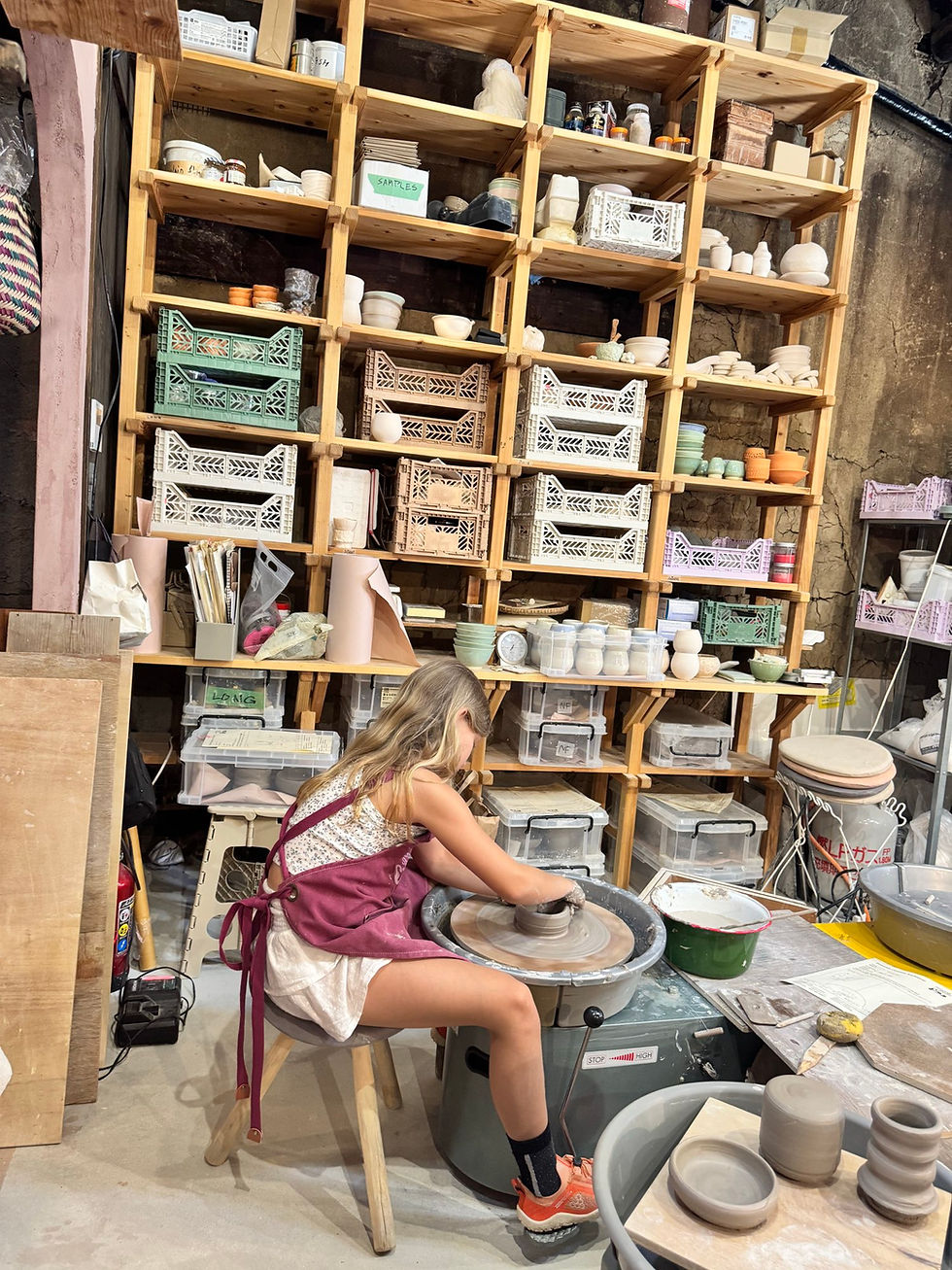
Across from me, Silja is at a pottery wheel. She sits at it with a confidence I can only watch and admire — her hands steady in the clay, her focus complete, the wheel turning under her fingers as if she has been doing this for years rather than minutes. She has not. She simply decided she could, and then did. This is very Silja.
She came to me at dusk, eleven years ago — my dawn child. Zora, her middle name. Dawn in Croatian. Born at the threshold between one light and the next, and she has lived there ever since — not quite the ending of one thing, not quite the beginning of another, but that particular in-between quality that belongs to neither dark nor full day and is more beautiful than either. A soul that carries its own light, from the inside out.
Denmark. A house with walls that stayed in place. A version of myself who had not yet discovered what she was capable of or what she actually needed. A woman who loved her daughter with everything she had and was still, in so many ways, in the early chapters of becoming herself.
Eleven years. I don’t count all the places and faces we have encountered together — there are too many, and counting somehow diminishes them. But I keep them all, pressed close, the way you keep things that have shaped you.
Silja, at eleven, is becoming.
She is still the stubborn one — fiercely, magnificently stubborn, in the way that will serve her enormously once the world catches up with how certain she already is about things. She is still intuitive in a way that sometimes startles me, reading situations and people with an accuracy that has nothing to do with experience and everything to do with something she simply arrived with. She is feisty. She is hungry — for more, always, for the next thing, the next experience, the next question she hasn’t asked yet.
But something is shifting, quietly and steadily, the way things shift in the years just before adolescence makes itself fully known. She is a little less impulsive than she was, a little more grounded. A little more willing to sit with something before reacting to it. Wiser, in the particular way that comes not from being taught but from having lived enough moments that the living itself has begun to teach.
She has an animal spirit she wears without self-consciousness — an aliveness, a physical certainty, a sense of being completely at home in her own body and in the natural world that I find both moving and humbling. She says yes to my crazy ideas, which matters enormously. And then she brings even crazier ones of her own, which matters more.
Last year we celebrated her in Croatia — both our families gathered under the heat of the summer sun, the kind of celebration that has roots in it, that holds history and belonging. This year she is eleven at a charcoal fire in Kyoto, learning pottery, about to discover Hokkaido for the first time.
She does not find this strange. This is simply her life, and she inhabits it completely.
Our conversations often begin: do you remember? And then a memory arrives between us — vivid and warm, suddenly present as if it never left — and we keep it there for a moment, close, smiling at each other with the particular joy of two people who have shared something extraordinary and both know it.
Walking Morris — the dog we were pet-sitting in Kojonup, Australia — across vast fields belonging to a sheep farm, collecting bones bleached white by the sun, comparing them, carrying the best ones home like treasure. Riding horses in Spain last autumn, her confidence in the saddle something she wore as naturally as her own skin. The morning she ran naked through our garden in Denmark on a frost-white day, feet on frozen grass, completely unbothered, completely herself. And a storm in a small fishing village in Mexico that flooded the cobblestone streets and how we didn’t run inside but jumped in the puddles instead, opening our mouths to catch the raindrops, laughing until our sides hurt.
These are the memories that begin with do you remember and end with us both smiling so completely there is nothing left to say.
There are so many of those already. And so many more waiting, even now, even today, even as we pack our bags and prepare to say goodbye to my beloved Kyoto and turn toward Hokkaido, which neither of us has seen yet.
I woke this morning with mixed feelings, the way I always do on leaving days — celebration and bittersweetness sitting side by side, the excitement of what is coming tangled with the ache of what is ending.
Kyoto has given me so much this visit. The moss temple and the way of water. The knife master and the name in the cup. The Bachata dancing and the shyness that melted and the appetite for more that took its place. An entire week that danced away with me, with all the people I met, with all the parts of myself I rediscovered on a dance floor in a city I love.
I am leaving a little more open than I arrived. A little more courageous. A little less fearful. This is what Kyoto does to me, every time. It asks something of me and gives back more than I brought.
Silja is still at the pottery wheel. The clay is taking shape under her hands.
I watch her and think about all the things I do not know — where we will be for her twelfth birthday, what Hokkaido will give us, what memories are waiting to be made that we will one day begin with do you remember.
We have our dreams and no idea how they will unfold, which used to frighten me and now, mostly, fills me with something closer to wonder.
She will figure it out. She always does.
My stubborn, intuitive, feisty, hungry, animal-spirited dawn child — becoming, steadily and magnificently, herself.
Happy birthday, Silja.
What a life it has been.
What a life it is still going to be.


Comments