
The Name in the Cup

Updated: Jun 4
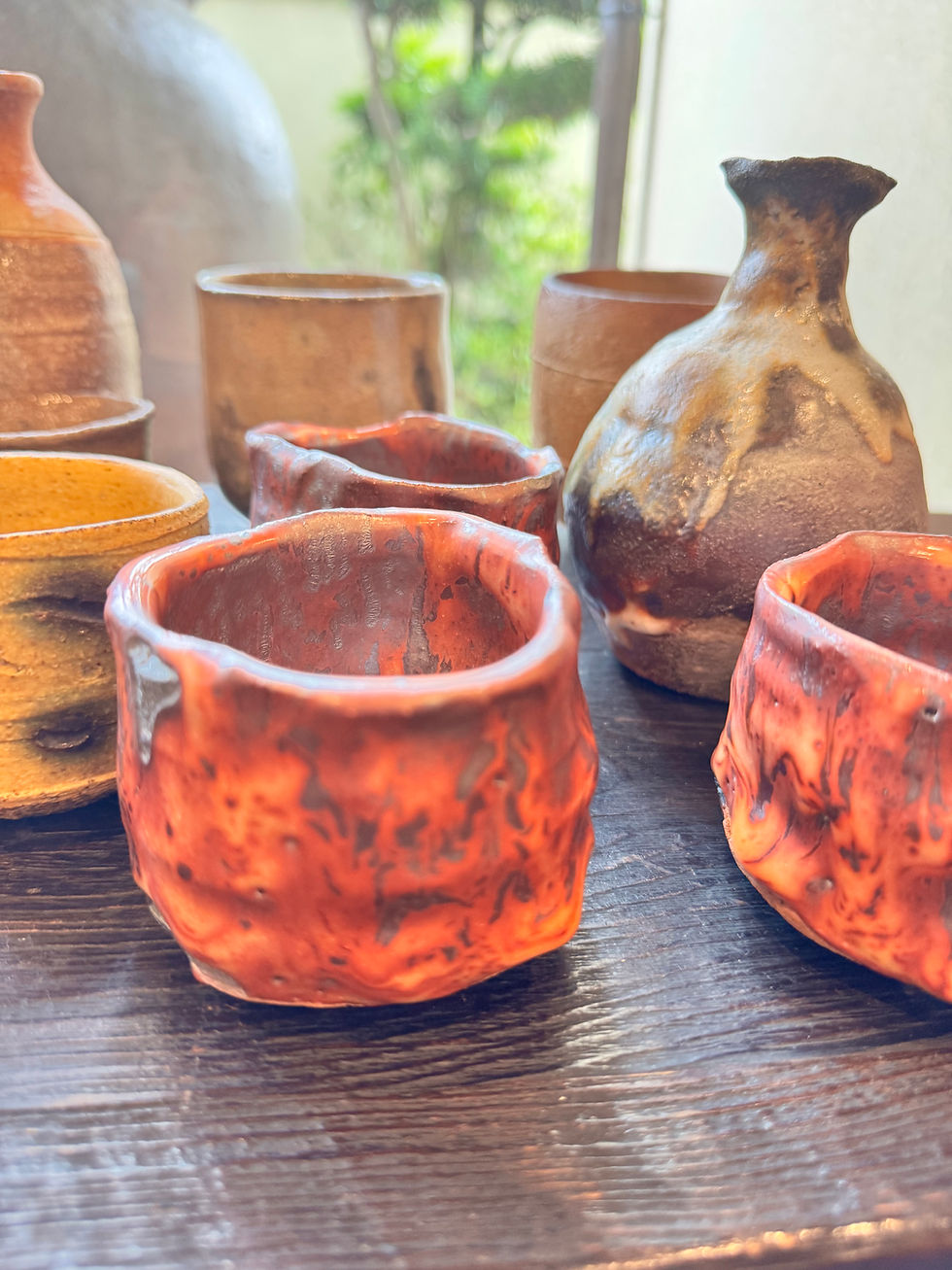
There are days that arrive quietly and become, without announcing themselves, something you will carry for a long time.
Today was one of those.
Ginkakuji area on a tender early afternoon. My dear friend Irene and I found ourselves at a small restaurant in this neighbourhood of Kyoto that holds its beauty without advertising it — old wooden facades, narrow streets that feel like they belong to a different century, the particular hush of a place that has not tried very hard to be discovered and is the better for it.
We ate slowly. This is not always something I manage — I am, by nature, someone who moves through meals the way I move through mornings when there is too much to do: with more speed than the moment deserves. But today the food asked to be looked at before it was eaten. And so we looked.
Each dish arrived as its own small composition. The ceramics it was served on — irregular, textured, glazed in earth tones that made the food glow against them — were as considered as the ingredients themselves. A piece of tofu placed just so. A scattering of something green. A sauce drawn in a steady small bowl of something deeply rich and luxurious. The kind of presentation that makes you understand, viscerally, that someone spent real time thinking about this moment — your moment, specifically, even though they have never met you.
I admired every detail. The way steam moved above a bowl. The weight of a ceramic spoon in my hand. The particular colour a broth takes on when it has been made with patience. Irene and I ate and talked and ate again, unhurried, and I felt the day settle into something spacious and good.
I had heard about Robert Yellin’s Yakimono Gallery — a gallery dedicated to Japanese ceramics, tucked into the Ginkakuji neighbourhood, run by an American collector who has devoted his life to the art of Japanese pottery. We decided to walk there after lunch not knowing if it would be open, the slow way, because the slow way was the right way for the day we were having.
On the way, we met him.
Robert was heading out in his dark green car— to pick up some art pieces, he explained, with the ease of a man entirely comfortable in his own rhythm — and he paused to greet us with the warmth of someone who genuinely enjoys the arrival of people who have come looking for what he loves. He told us to walk on to the Silver Temple — Ginkakuji — and come back in forty minutes. He would open the gallery for us then.
And so we walked.
Irene and I talked about Gathering Moss — Robin Wall Kimmerer’s book, which had been moving through my inner conversations like a quiet current since Saihoji. We talked about slowness and attention and the particular kind of seeing that mosses require of you. I told her that walking in the moss garden on Sunday had woken something in me — a hunger I couldn’t quite name at first, until we kept talking and I found the word for it.
Poetry.
I felt an exhausted, urgent need for poetry. Not the mild kind — the kind that arrives when you are moved past the point where prose feels sufficient. The kind that requires a different container for the feeling. Walking through Kagoshigawa in the late morning light, my knee aching quietly beneath me, I wanted to read poetry the way you sometimes want water — suddenly and completely, as if nothing else will do.
We returned to the gallery.
Robert welcomed us in.
What I encountered inside I am still finding language for.
Yakimono — Japanese ceramics — is a tradition spanning many centuries, many schools, many hands. But you do not fully understand that when you read it. You understand it when someone places a cup in your hands and tells you who made it.
Robert sat on the floor, barefoot unpacking wooden boxes full of treasures and firmly but quietly filled that place he have loved for a very long time — unhurried, alive to each piece, delighted by our attention without performing that delight. I would lift a cup. Turn it slowly. Feel its weight, its texture, the particular way the glaze had broken or pooled or feathered at the rim.
And then Robert would say a name.
Quietly. With care and with a kind of tenderness that I can only describe as admiration — not of his own collection but of the artist themselves, still present somehow in the object they had made.
Sometimes the name came with a year of death. Sometimes an era. Sometimes just the name and a brief, sure sentence about who this person had been, what they had pursued, what they had understood about clay and fire and silence.
Each time, something happened that I am struggling to explain but need to try: the name would fall into the cup I was holding. Settle there. And then, slowly, enter me — as if I was drinking not tea but the emotion and intention that the piece had been holding, across however many years, waiting for someone to hold it and receive it.
It felt like magic of the simplest and most profound kind. Not theatrical. Not performed. Just the invisible thread between a maker and a holder, with a careful, loving intermediary who knew both of their names.
Collector to admirer to artist and back again.
Something old made present.
Something present made eternal.
At one point Robert gestured to an old wooden Korean cabinet standing against the wall — worn smooth, the kind of dark honey colour that only comes from decades of hands. He suggested we open the drawers.
Many small drawers held a cup. Some were empty.
I opened the first one. A new piece. A new name. A new small world. I opened another. Another still. The cabinet became, with each drawer, something more than a cabinet — a portal, Robert said, and that was exactly the word for it. Each tiny rectangle of wood pulled open to reveal not just an object but a possibility. An invitation into the life and mind of someone who had made something beautiful and left it here to be found.
I stood at that cabinet for a long time.
I left carrying a cup in a bag full of something I can only call hopes and gratitude — the particular fullness of a person who has been given more than they expected from an ordinary Tuesday afternoon.
We walked the Philosopher’s Path afterward.
This famous canal-side path in Kagoshigawa takes its name from the philosopher Nishida Kitaro, who is said to have walked it daily in meditation. The stones are worn. The water beside you moves slowly and without urgency. The trees lean over it in a way that makes the light fall in pieces rather than all at once.
My knee ached. It has been aching for days now — a quiet, persistent reminder that the body has limits that training and intention cannot always override. I walked slowly, which was the only pace available to me, and found that the slowness was not a compromise but a gift. You see more from this pace. You hear more. The Philosopher’s Path does not reward hurrying.
There are struggles in me right now that I have not yet found the full words for. My own body, asking for patience I am still learning to give it. People I love, facing things I cannot fix. The particular ache of watching difficulty arrive in the lives of your dear ones and being unable to do anything except be present, which sometimes feels like so little even when it is everything.
Today held all of that — the tenderness, the ache, the unnamed struggle — and held alongside it the lunch and the walk and Robert and the names falling into cups and the cabinet full of portals and Irene’s voice and Gathering Moss and the need for poetry and the Philosopher’s slow, steady path beside its water.
I keep thinking about those invisible threads Robert spoke without speaking — the ones that run between the maker and the object and the hand that holds it, across whatever distance of time has accumulated between them.
I think those threads are what art is.
I think they are also what this life is — this particular, wandering, sometimes aching, always searching life we have chosen.
Thread after thread of connection, gathered from a wooden cabinet drawer here and a ceramic cup there and a conversation on a slow walk and a friend who reads the same books you do and knows when to be quiet and when to say the thing.
Today was full of threads.
I am still holding all of them.
Carefully, the way you hold a cup that has a name.


Comments