
Mori: 23 bites of heaven

There is a particular kind of gift you can only give yourself.
Not bought in a shop or wrapped in anything. Not organised by someone who loves you, however thoughtfully. It is the gift of choosing, entirely on your own authority, to do something that feels extravagant and slightly terrifying and completely worth it — and then walking through the door anyway.
On May 5th, I walked through the door of Mori.
I only found out after the evening what the name means. Mori — 森 — is the Japanese word for forest.
I sat with that for a long time when I learned it.
Forest and water are the two places where I have always found myself most completely. Where the noise inside quietens without effort. Where something that has been contracted begins, slowly, to open. I did not know this when I arrived. I only knew I was going to dinner, alone, in a restaurant I had been trying to reach for weeks. But perhaps some part of me felt it — the rightness of the place, the particular quality of peace that settled over me from the first moment I sat down. Forest named for a woman. Sitting at the edge of the sea. Holding, without knowing it, exactly the two things I love most.
That is the kind of detail that makes you believe the universe has a sense of poetry.
The restaurant had been on my radar since before we arrived in Busan. In Seoul I had been searching for somewhere truly special — a fine dining experience that felt like an occasion, the kind of evening you carry with you long after the plates are cleared. I found nothing that quite fit. So when we arrived in Busan I tried again, and Mori appeared: a Michelin-starred kaiseki restaurant, only steps from where we are staying, its first star awarded in 2024 as part of the inaugural Seoul and Busan Michelin Guide.
Getting a reservation, it turned out, was another matter entirely.
The moment bookings opened for the second half of May, they were gone — vanished in minutes, which made more sense once I discovered that Mori seats only eight people per service. Eight. The intimacy is not incidental; it is the whole philosophy.
My husband, undeterred, suggested we search for single seats available on different dates. May 5th had one.
And so I did something I had never done before: I booked a table for one at a Michelin-starred restaurant and took myself to dinner.
Mori was named by Chef Kim Wan-gyu for his Japanese wife — the woman who runs the front of house with such unhurried, attentive grace that you feel, from the moment you arrive, that you are being genuinely cared for rather than merely served. Forest, named for a person. Love made into a name made into a place.
There is something deeply right about that.
Chef Kim’s story is worth knowing too. He worked as a cook in Korea, then at 29 made the decision to leave — to go to Japan, to train seriously, to study at Tokyo Sushi and Cuisine School and immerse himself in the rigorous, contemplative tradition of kaiseki. He returned to Korea at 35 and opened Mori: bringing the Japanese form home and rooting it entirely in Busan’s identity as a port city, one of the world’s great seafood destinations. The result belongs fully to both places and entirely to neither. It is its own living thing.
The menu is never fixed. Chef Kim follows a monthly framework but adjusts constantly — to the weather, to the market, to what the sea is offering that particular morning. He has described it simply: today we have what the season brings, and the season is always changing. Expecting the unexpected is built into the experience. You arrive not knowing exactly what you will eat, trusting completely that whatever appears has been chosen with total care.
I find that philosophy deeply appealing for reasons that have nothing to do with food.
I arrived a few minutes early and discovered, to my surprise, that I was the last of the eight guests to be seated.
Chef Kim’s wife welcomed me at the door in a kimono that seemed to carry its own atmosphere — a different register of time and attention than the street I had walked in from. She escorted me to my place at the far end of the long counter, positioned directly opposite the kitchen, where Chef Kim and his team were already in quiet, purposeful motion.
Five people served that evening. Five, for eight guests — a ratio that tells you everything about what kind of experience this is. Not efficiency. Devotion. Every movement was considered. Every plate was carried with both hands. The five of them moved around each other in the kitchen with the wordless coordination of people who have practised something together until it becomes a kind of dance.
My place was set simply and beautifully: dark chopsticks resting on a ceramic holder shaped like a snow pea, wrapped in a small paper sleeve stamped with the Mori kanji in red. A folded white towel. A green leather menu card embossed with the same character — 森. Even before the food arrived, I understood I was somewhere that took the details seriously. All of them. Even the ones you might not notice. Especially those.
What unfolded over the next two hours was a choreography unlike anything I have experienced at a table. Twenty-three courses, each one a small, complete world. Before every serving left the kitchen, Chef Kim tasted it himself — not as performance, but as the final, quiet act of responsibility a craftsman takes for what he sends out into the world.
I ate slowly. I paid attention. The jazz I usually need to fill the silence was not necessary here. The room had its own music.
The Opening: Four Small Worlds
The meal began with four preparations arriving together on a single textured slate — an overture that introduced the evening’s intentions all at once. A golden croquette of fried cutlass fish on a small wooden skewer: crisp, savoury, a perfect single bite. A small round dish of simmered tender octopus, its tentacles lacquered in a glossy amber glaze, yielding and deeply flavoured. A cool, pale preparation of hard clam — ethereal, oceanic, almost disappearing on the tongue. And egg cockle with deep-sea whelk, served in their own shells, decorated with tiny wildflowers and fresh green leaves that made the whole arrangement feel like something gathered from a forest floor and a tide pool simultaneously.
I sat looking at it for a moment before touching anything. It felt wrong to disturb it. And then immediately right.
Snow Crab Sushi
One piece. Nothing superfluous. The snow crab was clean and sweet in the way that only the freshest seafood can be — a flavour that arrived complete and then lingered far longer than its size suggested it should. A reminder that the most honest food asks very little of you except to slow down and notice.
The Soup: Fish Cake in Swimming Crab and Kelp Broth
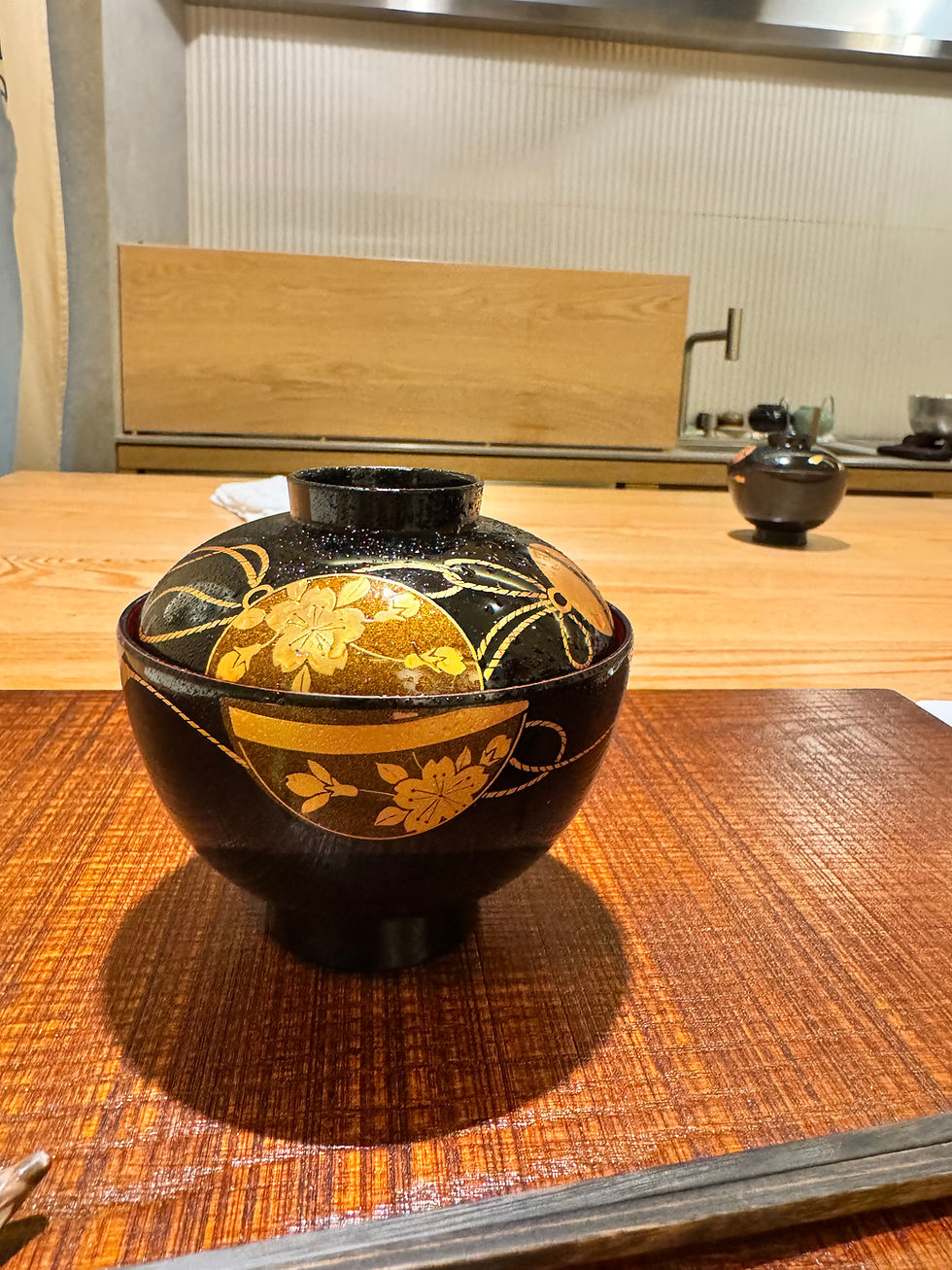
The lacquered soup bowl arrived closed — deep black, painted in gold with cherry blossoms and ribbons, a small ceremonial object resting on the counter. Lifting the lid was its own ritual. Inside: a luminous, clear broth of swimming crab and kelp, with a soft fish cake resting at its centre. The broth was extraordinary — clean and deep simultaneously, the kelp present as a whisper of umami that revealed itself slowly.
I held the bowl with both hands and understood why soup deserves a beautiful container. The vessel is part of the taste.
Parrot Fish, Sea Bream, Dokdo Shrimp and Sea Urchin
Before this course, something remarkable happened. A small wooden box was brought to the counter and set before us — inside, the evening’s Dokdo shrimp, still alive, still moving, presented to us whole before they were prepared. It was not theatrical. It was respectful. An acknowledgment that something living was about to become our meal, and that this deserved a moment of recognition.
The sashimi arrived on an octagonal hand-painted plate — parrot fish and sea bream sliced into translucent, pearl-coloured pieces, the shrimp now transformed into something silken and sweet, a golden sliver of sea urchin alongside, and a spray of fresh green leaves arranged as if growing from the plate itself. A small dish of soy. Fresh wasabi. The fish had the particular quality that only exists when the distance between ocean and plate is measured in minutes rather than days. I have eaten a lot of sashimi in my life. I have never eaten sashimi like this.
Hard Clam — Steamed, with Ikura and Spring Vegetables
Served in a deep red lacquer bowl, the clam sat in a pool of clear, delicate broth alongside crisp bamboo shoot and tiny pearls of bright orange ikura — salmon roe that caught the light like small jewels. A sprig of fresh herb across the top. The combination of the briny clam, the grassy bamboo, and the pop of the roe was unexpected and then immediately inevitable, the way the best flavour pairings always are.
Char-grilled Eel
This arrived on a rough, dark ceramic plate and stopped me entirely. The eel was grilled over charcoal until the skin blistered and caramelised into something deeply savoury and smoky, then laid over a crisp rice cake topped with a precise dot of wasabi. Shaved daikon and fresh herbs sat on top, their cool freshness cutting perfectly through the richness of the fish below. Beside it on the plate: the charred ceramic itself, matte and earthy, making the golden eel glow. Char-grilled eel is a classic of Japanese cuisine, but I have never had it taste quite like this — like the sea and the forest had met in the fire and come out as one thing.
Abalone with Noodles, Abalone Sauce — and Korean Beef Shabu Shabu with Ponzu
A double course, two preparations arriving together. The abalone came in a glass bowl over a delicate pool of its own sauce — translucent slices alongside glass noodles, crowned with black caviar and a small quenelle of wasabi, finished with sliced spring onion. Luxurious without being heavy.
And alongside it, thinly sliced Korean beef for shabu shabu — barely cooked, draped over fresh herbs on a white rectangular plate, with a vivid ponzu dipping sauce in a painted ceramic dish beside it. Eating these two side by side was a study in contrast: the oceanic depth of the abalone against the clean, bright citrus of the ponzu-dipped beef. I kept going back and forth between them, unable to decide which I loved more.
Fried Sweet Fish, Conger Eel and Asparagus
Three things on a single weathered stone plate, each cooked differently, each its own complete experience. The sweet fish — ayu — arrived whole and tempura-fried, its delicate river flavour intact inside the gossamer batter, its eye still looking up at me with a kind of dignity. The conger eel was fried golden and satisfying alongside it. And the asparagus had been tempura-battered too, its vivid green just barely visible through a coating so light it seemed barely there at all. This course had a playfulness the others didn’t — it made me smile.
The Rice Course: Seasoned Rice with Rosy Seabass and Bamboo Shoot
The rice arrived in two stages, as it does in kaiseki — first the ceremony of seeing it, then the eating of it.
A large clay donabe pot was carried to the counter and its lid lifted to reveal the rice still cooking inside: rosy seabass fillets laid across a bed of seasoned rice and fresh bamboo shoot, the steam rising, the smell of it filling the air around me in a way that felt like arrival, like something completing itself. The rice was then served in a blue-and-white patterned bowl — seasoned simply, the fish folded through it, the bamboo adding a faint sweetness, accompanied by a deep red bowl of miso soup with leek and kelp, and small side dishes of pickled green pepper and braised kelp. After everything that had come before, this felt like coming home. Like the meal exhaling.
The Ending: Green Tea Ice Cream and Watermelon
The final course arrived in a rough volcanic-stone bowl — a generous scoop of green tea ice cream, pale jade-coloured and intensely flavoured, with three small rounds of watermelon beside it and two fresh mint leaves resting on top. Cool, clean, unhurried.
The perfect final word after twenty-two courses that had been, collectively, one of the most extraordinary conversations I have ever had at a table.
I sat for a moment after the last bite and did not want to move.
I walked home through Busan in the dark, slightly full and entirely grateful, carrying something I am still finding words for.
Mori gave me the forest and the sea in a single evening — in broth and flame and ice, in shrimp that had been alive minutes before, in a soup bowl painted with cherry blossoms, in five people moving with quiet devotion around eight guests who had simply shown up and trusted. It gave me the thing I have been searching for since we arrived in this city: a space where someone was doing exactly what they were meant to do, with complete commitment, without compromise.
It reminded me that beauty is not always where you expect to find it. That a city can withhold itself for weeks and then offer you something like this — a forest named for love, sitting at the edge of the sea, serving twenty-three small, perfect reasons to believe that the difficult weeks are worth it.
I took myself to dinner.
And the forest and the water were both there, waiting.
They always are, when you are finally ready to arrive.


Comments